Published August 2, 2026 · Updated August 14, 2026
How to Host a Retreat in Bali: A Planning Guide
Most guides to hosting a retreat in Bali are written for people who want to attend one. This one is written for the person who has to make it happen: the organiser who has a programme, a group to fill it, and a growing list of logistics that nobody signed up to run. If your group is a company team rather than an audience you have to sell places to, most of what follows still applies, but the money and the timing work differently: corporate retreats and team offsites is the version written for that.
The order of your decisions matters more than the speed of them. Here is the sequence that causes the fewest problems later.
Table of Contents▼
- 1. Decide the shape of the retreat before you look at venues
- 2. Understand what whole-venue hire changes
- 3. Ask what "full service" actually covers
- 4. Look at the spaces you will actually use
- 5. Brief the kitchen properly
- 6. Plan around the season, not the weather forecast
- 7. A timeline that holds up
- Where to start
1. Decide the shape of the retreat before you look at venues
Three numbers decide almost everything else, and they are worth settling before you look at a single photo.
How many guests. Not the number you hope for, the number you can fill without discounting. A venue that sleeps 22 run at 12 is a very different budget from the same venue run at 20.
What room mix you are selling. Solo travellers who want a private room, couples, and friends happy to share are three different products. Count your rooms and bathrooms before you publish a price, because a shared-bathroom retreat and an every-room-ensuite retreat attract different people and cancel at different rates.
How many hours a day you are actually teaching. Two sessions a day with long open afternoons needs quiet corners and water more than it needs a bigger hall. A dense schedule needs a practice space that can be reset quickly between sessions, and someone to reset it.
2. Understand what whole-venue hire changes
Booking rooms in a hotel and hiring a venue outright are not the same purchase. With exclusive use, the property runs on your timetable: your start times, your meal times, your silence, your music. Nobody is sunbathing through your closing circle.
It also changes how the group behaves. People relax faster when the only faces they see belong to their own group, and that is worth more to the experience than any single facility on the list.
The trade is that you carry the whole property. If you have not filled it, you are still paying for it, which is why the numbers in step one come first. The decision underneath this one, whether to take a staffed venue at all or hire a villa and run it yourself, is worth its own hour: full service or a villa you run yourself sets the two side by side.
3. Ask what "full service" actually covers
Full service means different things at different properties, and the gap between them is measured in your own hours. Ask, in writing:
Who sets up the practice space before each session, and who resets it afterwards? Who is on site overnight? Who handles a guest who arrives at 2am, or one who gets ill on day three? Who does the airport transfers, and who is the single person you contact when something changes?
The answer you want is a named team, on site, employed by the venue. At Basundari that is a Balinese team covering hospitality, housekeeping, the kitchen, maintenance and security, so the organiser is running the programme rather than the property. The full line-by-line split, including the parts that are genuinely shared, is set out in what a retreat venue handles and what you handle.
4. Look at the spaces you will actually use
The photographs will sell you the pool. The retreat is decided elsewhere.
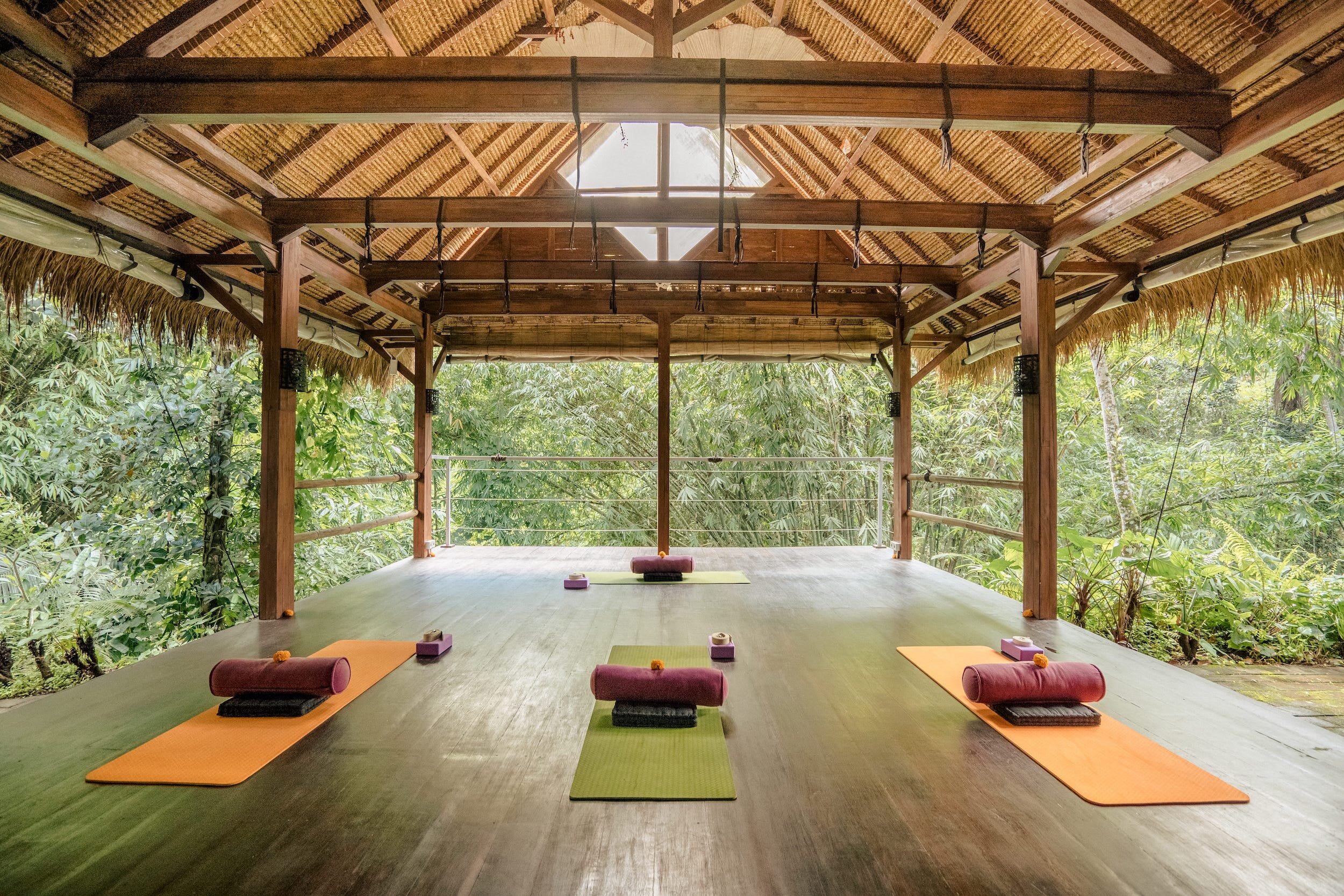
The practice space. Ask for its dimensions and its capacity in mats, not in people. Our shala is a 65m2 open bamboo space that takes 22 mats, or 15 aerial yogis on rigging. Ask what happens in heavy rain, and how loud the room is when it does.
Recovery. A sauna and an ice bath change what you can programme, and they change how the afternoons feel. So does having two pools rather than one, because a group of 20 does not want to share a single body of water for a week.
Places to be alone. Retreats fail on togetherness fatigue more often than on programme quality. Count the spots where one person can sit apart and still be inside the property: decks, meditation corners, a quiet edge of the garden.
5. Brief the kitchen properly
Food is the thing your guests will describe most vividly when they get home, and it is the thing organisers under-specify most often.
Send dietary requirements as a list of people, not a list of labels: one coeliac, two nut allergies, one who does not eat onion or garlic reads very differently to a kitchen than "some dietary requirements". Send it before arrival, not on arrival.
Then agree the rhythm: what time each meal lands, what happens after a late session, and whether anything is available between meals. Our menu is plant-based, Western and Asian, cooked by Ketut and Andreas and served family style, and the customisation happens in the planning call rather than at the table.
6. Plan around the season, not the weather forecast
Ubud runs year round, and the practical constraint is rarely rain. It is availability: the dates experienced organisers want are taken first, and the good venues are booked further out than first-time organisers expect.
Work backwards from the date you want to run. Twelve months out is comfortable. Six is workable. Three is possible, but you will be selling into a shorter window, and selling is the part that decides whether the retreat happens. How far ahead to book a Bali retreat venue takes that month by month, including what to do when the date you want is already close.
7. A timeline that holds up
9 to 12 months out. Fix the dates and the venue. Nothing else can be promised until these two exist.
8 months out. Publish the price and open bookings. Decide your deposit and your cancellation terms now, in writing, before anyone has paid you anything. If you are hiring here, our booking terms set out what we need and when. What sits behind the number you are quoted, and why no venue can give you one before it knows your group, is covered in what decides the cost of a retreat venue.
6 months out. Programme in detail: session times, teachers, any external practitioners, any excursions.
3 months out. Start collecting rooming preferences, dietary requirements and flight details from your guests. The venue does not need them yet, but you will need weeks to get twenty people to answer.
1 month out. Hand all of it over. Here that is two short forms, one for logistics and one for add-ons, returned within a week, with add-ons invoiced about a fortnight before you arrive.
1 week out. Final numbers, final schedule, and one call with the venue team that walks through the week day by day.
Where to start
If you have your dates and your group size, the next useful step is a conversation about whether the property fits the retreat you are planning, rather than a brochure. Tell us the shape of your week and we will tell you honestly whether Basundari works for it, or whether it does not.
Basundari is the perfect setting to host your retreat. Whether you specialize in yoga, meditation, mindfulness, breathwork, wellness, dance, arts, leadership, massage, fitness, pilates, inspiration, healing, or personal development, Basundari is designed to support all types of retreats. Reach out to us, and we'll ensure your needs are met.
Plan the perfect retreat